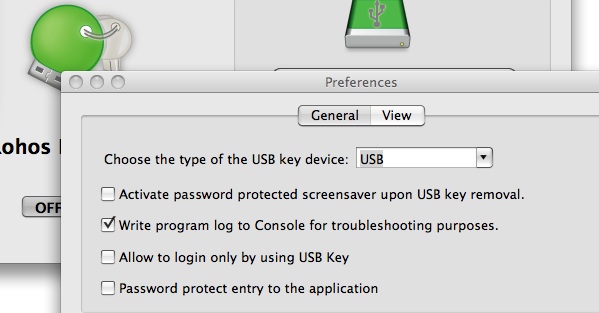
Credentials Prompt of RDP 6.0 and login with USB Key

Microsoft Remote Desktop Connection 6.0 (on Windows Vista\Seven) by default makes it mandatory for the user to enter user name and password before RDP client can establish connection to the WinSeven/2008 remote server (“ Enter your credentials for <server>. These credentials will be used when you connect to the remote computer” ). This is called “ Network Level Authentication“. If you are going to use USB key you can skip this prompt or disable it.
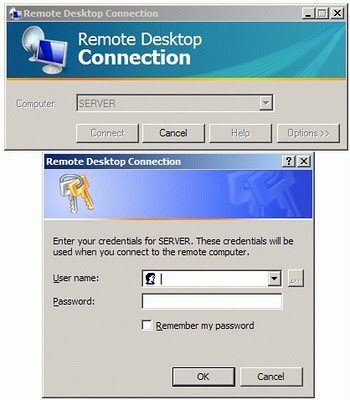
on vista you will see
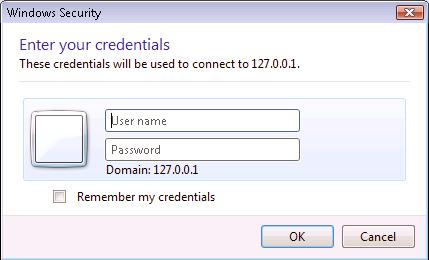
As Rohos Logon Key RDC plugin works with the established terminal session this Credentials Prompt may be ignored or disable it by default.

Actually if Rohos Logon is installed locally it could work in this ‘credential prompt’ window:
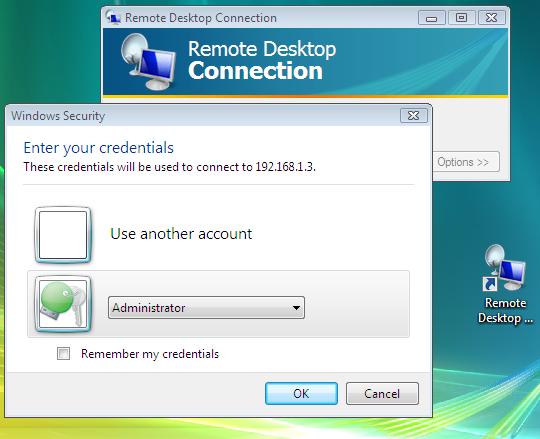
How to disable RDC Credentials Prompt:

To skip the credentials prompt – choose “Do not attempt authentication” under Authentication options on the Advanced tab, but this option is not set permanently. To permanently skip the additional credential screen , edit the Default.RDP file (My Documents folder) in notepad. Including enablecredsspsupport:i:0 disables the Credentials Security Service Provider for the connection. If you use separate .RDP files for different server, modify each of those .RDP files. Below is the content section of the default.rdp file with enablecredsspsupport:i:0 option included.

redirectposdevices:i:0
authentication level:i:0
enablecredsspsupport:i:0

prompt for credentials:i:0
negotiate security layer:i:1

Note that this workaround is suggested only if you connect Windows 2000/2003/XP systems because according to Terminal Services Team blog post – “This option does disable the new credential prompting behavior, but it also disables support for Network Level Authentication for Vista (and Longhorn Server) RDP connections; Network Level Authentication requires credentials to be provided by the client before a session is created on the server side.” So if you do connect to Vista over RDP, you’ll not be able to use this option.


Rohos Logon Key v.2.7 for Windows Seven

Windows Seven support for Rohos.

Rohos Logon Key v.2.7. offers two-factor authentication solution for Windows Seven based on various USB tokens and authentication devices. By using a strong and secured password stored on a USB token you can improve your computer security.

What’s new in Rohos Logon Key 2.7:

  • Updated installer:
    – Now Setup package copy correct help file according to installation language
    + Added Japanese and Chinese languages
  • Supports new USB tokens and authentication devices:
    + Touchatag RFID proximity tags (former TikiTag).  Wireless tags for Windows logon.
    + Swekey OTP token (Offline + Online validation, see Options link )
    + Securetoken ST2, ST3 (PKCS11 based tokens). ST3 has an auto-install feature.
    + Senselock trueToken EL (ultra-small PKCS11 based token)
  • Improved Windows Vista/Seven support
    – fixed Rohos Logon Credential icon in Vista UAC dialog. Now USB tokens with PIN code can be used to get credentials for any elevation.
    – fixed Windows Remote Desktop support.
  • Major improvements in  ‘Bluetooth logon’ feature.

Read more…

Rohos Logon Key v.1.7.2 for Mac OS X

Tesline-Service Announces Rohos Logon Key v.1.7.2 for Mac

Chisinau, May 05, 2009 – Tesline-Service SRL today announced that its Rohos Logon Key authentication solution for Mac OS® X Tiger and Mac OS® X Leopard now supports two-factor authentication with any USB flash drive and PIN code.

Mac OS X security benefits:

  • Access your Mac with hardware USB key
  • The Mac is protected but you don’t need to enter your password manually each time you unlock your Mac
  • Automatically lock your MAC screen when USB Key is unplugged
  • Unlocking your MAC with a USB token is fully automatic and fast!
  • PIN code option offers two-factor authentication

Read more

Rohos Logon Key v.2.7 beta: Senselock, Swekey, Touchatag, Securetoken

(updated 30 June)

Rohos Logon Key v.2.7. – two-factor authentication solution for Windows now supports the new types of USB tokens and authentication devices, improved Windows Seven support.

Read more

Touchatag – wireless tag for Windows and Mac logon

Touchatag (former TikiTag) – technology that enable to connect the real world objects with a computer and Internet. The project was launched in 2008 by the Alcatel-lucent. The technology is based on RFID tags reader + tags + program on the local computer + Web service.

With the help of such technology interesting ideas could be brought into life, such as:

  • E-pass (access control) – give tags to users, and upon the tags being brought to USB reader the logging into Windows / Mac or Web site is performed automatically. For example, you can “stick” tikitag on your mom’s notebook – come up to the computer and the mail opens. To “stick” it on a child’s toy – run it over the reader – and the game is launched.
  • E-catalog of goods (logistics) – to all things (book / folder / item) could be stuck or sewed in the RFID tag. Run it over the reader and the thing is registered.
  • Location is not important: Touchatag – is a centralized technology (there is a Web server), so all Usage Examples that are set up on one computer work on all computers where there is USB reader tikitag.

TouchaTag RFID tags are supported in Rohos Logon Key v.2.7 and Rohos Logon Key for Mac v.1.7 – in order to provide the solution for Windows / Mac authentication  by using RFID tags.

Read more

Access your Windows computer with YubiKey

The video shows thorough instructions on how to set up and use YubiKey for secure Windows logon. “Also Rohos Logon Key supports YubiKey with static password and dynamic OTP” – says Alex. “As an additional level of protection Rohos Logon doesn’t allow to type in the OTP manually, denying such OTPs.”

Access Remote Desktop with YubiKey

The video shows how to set up YubiKey for Remote Desktop access. “In order to use YubiKey for RDP you need to install Rohos Logon Key Server Version“- says Alex. “USB Key Management Utility from Server Version allows you to add and set up Yubikey.” To learn more on how to set up YubiKey in Rohos Logon Key please, read

Rohos Logon Key v.1.6 (Mac)

We announce Rohos Logon Key v.1.6 (Mac) beta with a few improvements:

  • Fixed bug when password contains space ” “and comma “,”
  • Fixed bug with Bluetooth logon when Rohos Logon locks desktop right after USB key setup
  • Improved OFF function – when there are no USB key inserted all USB Keys will be removed from Rohos Logon
  • Added global Autostart item for Rohos Logon. Now after installation Rohos Logon icon will be active in all user accounts


Rohos Logon Key 1.5.2 for Mac

Here are new Rohos Logon Key v1.5.2 for Mac OS X.

It includes new features in Preferences pane:

  • Allow to log in only with USB Key. If this option is ON then regular password based logon dialog box will be disabled and covered with a half-transparent Rohos Icon. To log in you need to have USB Key. No emergency logon is enabled here except safe mode boot.
  • Password protect application, if it is ON then you need to pass system authentication window (to get Admin rights) to modify settings or access Rohos main window.

Some things were improved:

– installation script and now it installing all Rohos items (logon bundle, autostart item)
– Add USB Key function now would not ask for a password so many times
– Case-sensitive file system support, thanks to users reports.

Also, now it is possible to set up USB Keys on any other Server Mac, but you will need to manually copy Rohos *.k files into /Applications/.rohos folder on client Mac. We are still working under server-based usage of Rohos.

Windows Seven experimental support.

Recently we tried to install the latest build of Windows Seven (Windows 7 betta 1 7000) to verify Rohos Logon Key compatibility. The first test was ok – Rohos Logon Key works.
Looks like Microsoft developers did not change anything in the logon and credential providers API and thus we can relax instead of digging into Windows 7 cookbook’s 🙂
Today we uploaded the fresh release of Rohos Logon Key with Win7 support and other corrections.